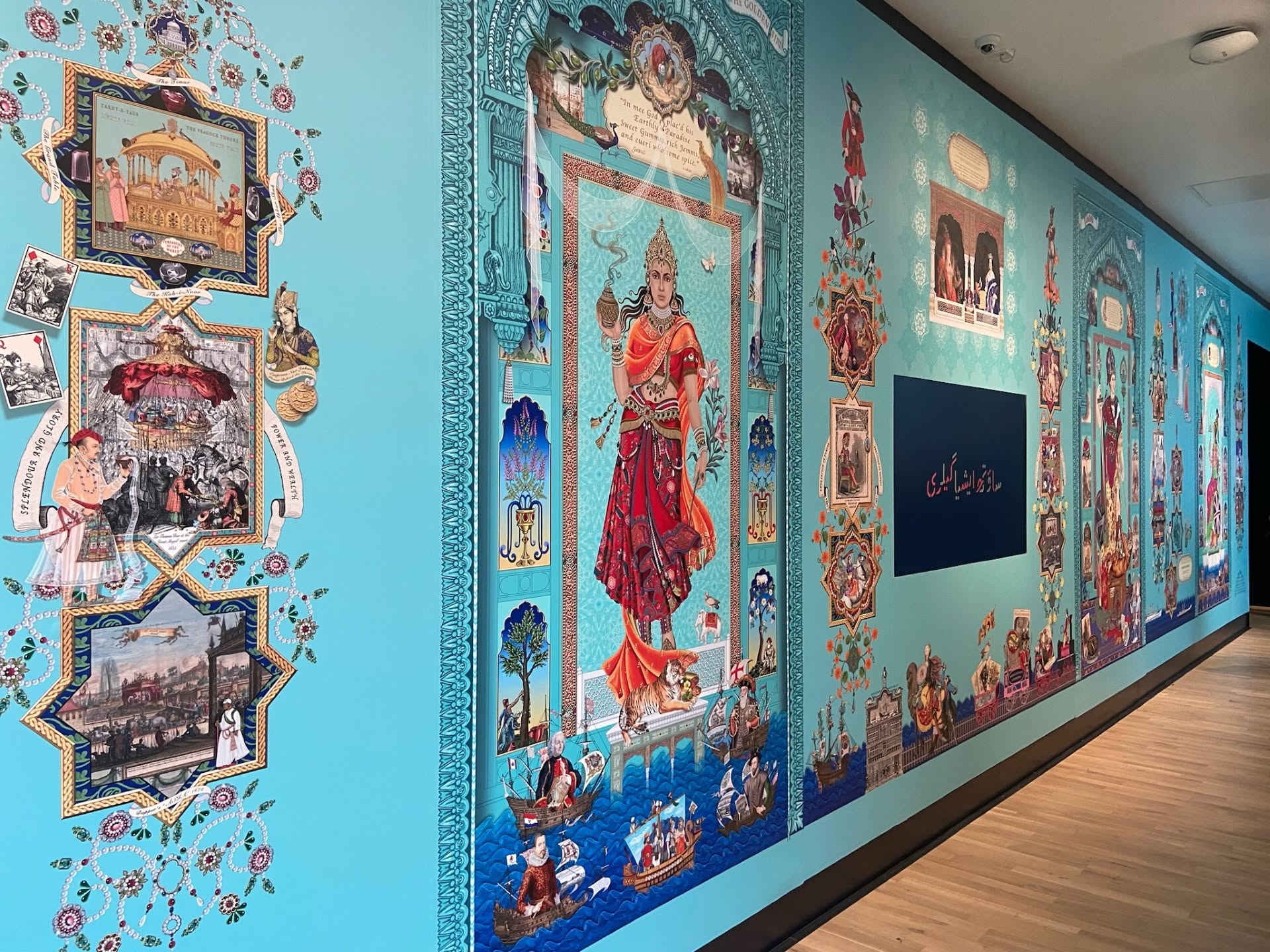


L’équipe MUSEA poursuit sa réflexion sur la représentation des voix marginalisées dans les musées et les expositions itinérantes le lundi 19 octobre (17h-19h, salle 2.44).
Nous accueillons Linda Pillière (LERMA) pour une présentation intitulée:
« Who Gets to Speak? A Stylistic Approach to Museum Narratives »
contact:
Résumé
Museums do not simply display objects: they tell stories. Through labels, wall texts, audio guides, digital interfaces, spatial organisation, and other forms of mediation, museums construct narratives about people, places, histories, and identities. In doing so, they also establish particular voices and positions of authority: they determine who is entitled to speak, whose experiences are foregrounded, and which perspectives remain unheard, marginalised, or absent. Traditionally, museum narratives have tended to be relatively singular and authoritative, presenting institutional interpretations as established knowledge and thereby reinforcing dominant historical narratives and societal norms.
In recent decades, however, museums have increasingly sought to rethink how they tell stories, moving towards more inclusive forms of narrative that acknowledge multiple perspectives and previously marginalised voices. This shift raises important questions about how such voices are actually brought into the museum narrative. How are different perspectives represented through language and other semiotic resources? How is authority redistributed—or retained—when museums seek to incorporate alternative voices? And to what extent do these new narrative strategies genuinely challenge established ways of telling and framing the past?
Drawing on approaches from discourse analysis, spatial discourse analysis, critical linguistics, and sociolinguistics, this paper examines the multimodal and stylistic resources through which museums construct, frame, and negotiate narrative voice. Examples are drawn from a range of museums in the United Kingdom, including the Manchester Museum, the London Postal Museum, the Museum of Liverpool and the Burrell Collection in Scotland. Particular attention will be paid to lexical selection, grammatical agency, modality, pronoun use, and narrative framing, alongside the spatial positioning of objects, texts, and other interpretive materials. By bringing linguistic and spatial dimensions together, I will explore how museums give voice to different actors and experiences, and consider the extent to which contemporary museum storytelling succeeds in moving beyond a single authoritative narrative towards more diverse and inclusive ways of telling.